




How oral administration of cannabinoids works
Oral preparations are familiar dose forms. They are similar to other medicines patients already take and are easy to administer for patients who can swallow. The ease of dosing is offset by intra- and inter-patient variability. While there is a positive dose-concentration relationship for most dose forms (solutions, tablets, capsules), oral THC and CBD have a highly variable pharmacokinetic profile, which differs between formulations.
Absorption is slow and erratic within the gastrointestinal tract. Significant first-pass hepatic metabolism and high lipid solubility mean 5-10% of the administered dose reaches the systemic circulation.
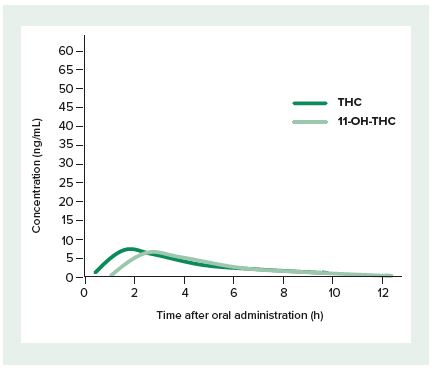
THC is metabolised in the liver to the major pharmacologically active metabolite 11-OH-THC, which occurs in approximately the same concentration in the blood as the parent compound, THC. Therefore, the bioavailability of parent and metabolite, which are both active, results in an elevated bioavailability.
The high variability in the THC and CBD absorption of oral formulations results in delayed peak plasma concentrations compared to other routes of administration. Therefore, the accuracy of determining a therapeutic dosage is reduced for individual patients.
Following oral ingestion, THC maximal plasma concentrations are reached after 60-180 minutes, reaching maximal clinical effects after 60-180 minutes and tapering off after 6-12 hours, depending on the dose.
Oral pharmacokinetic profile
| Bioavailability | Up to 10% |
| Peak plasma concentration | 60-180 minutes |
| Onset of clinical effects | 2-3 hours |
| Duration of action | 6-12 hours |
Pharmacokinetic profiles
An oral THC dose is typically lower than a CBD dose, resulting in different pharmacokinetic profiles. For example, a 20 mg THC oral dose may reach a Cmax of 7.9 ng/mL after approximately 135 minutes, while a 1500 mg CBD oral dose may reach a Cmax of 541 ng/mL after approximately
150 minutes.
THC metabolism occurs mainly in the liver, catalysed by CYP450 enzymes. THC undergoes extensive first-pass metabolism, primarily by hydroxylation to 11-OH-THC, which is an active metabolite. Both THC and 11-OH-THC are present in approximately equal concentrations in plasma. As would be expected, CBD is also subjected to significant first-pass metabolism.
THC and CBD are widely distributed, particularly in adipose tissue. Body storage of THC increases with increasing frequency and duration of use.
Reducing variability in oral dosing
The absorption rate is affected by gut physiology, diet, and general stomach health. The low bioavailability (< 10%) makes it difficult to titrate doses.
Patients should be advised to take their medicine consistently, with regard to time and dietary intake, to reduce variation.
For THC, an appreciable food effect is observed with highfat, high-calorie meals, resulting in an up to a 4-hour delay in mean Tmax, while Cmax is not significantly changed.
Administration of high-dose CBD with high-fat/high-calorie meals markedly increases Cmax and reduces the total variability compared with the fasted state.
Subscribe to our newsletter
Stay informed with our latest updates by subscribing to our newsletter for exclusive news and compelling content. Rest assured, we prioritize the integrity of your inbox, delivering quality over quantity, with newsletters dispatched judiciously.